
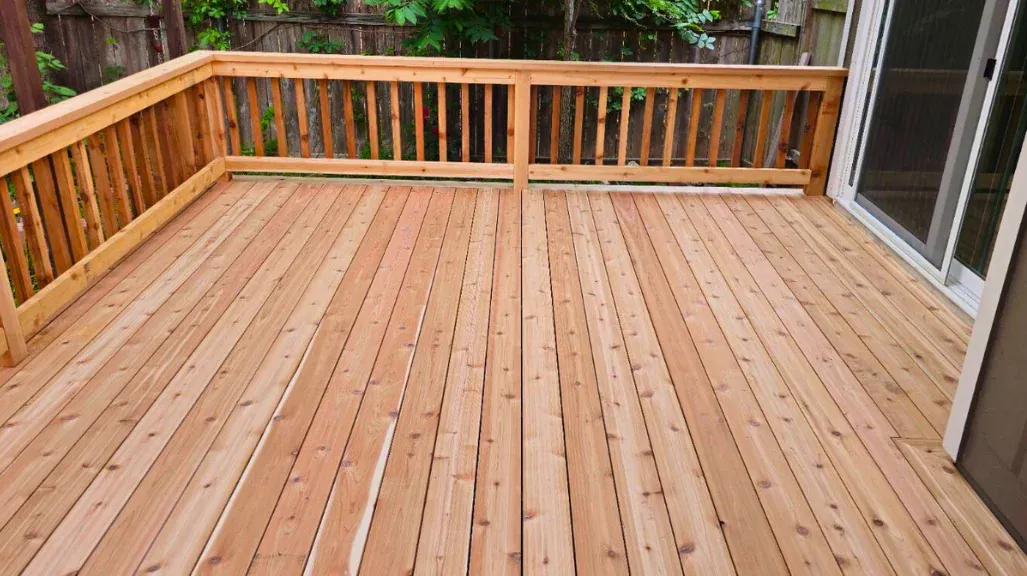
Composite and cedar are the two most common deck materials in the Cedar Park metro, including high-end builds in Cedar Park proper, and the right choice depends on what you value most. Composite wins on long-term maintenance, durability, and resistance to Texas weather extremes. Cedar wins on natural wood feel, lower upfront cost, and the visual warmth that engineered boards can’t fully replicate. This guide breaks down the differences across lifespan, surface temperature, maintenance, and aesthetics so you can match the material to your property and how you actually use the deck.
Call (512) 566-7520 for a free walkthrough. We’ll discuss your usage patterns, sun exposure, and aesthetic preferences before recommending a material.
Quick Answer: Composite vs Cedar Deck
Composite costs about 30-50% more upfront but eliminates the need for refinishing and lasts 25-30 years in Texas. Cedar runs cheaper at install but needs sealing every 2-3 years and lasts 18-22 years. Heat performance and maintenance resolve most decisions for Texas homeowners.
Side-by-side comparison:
|
Factor |
Cedar |
Composite |
|
Upfront cost installed |
Lower (~30-50% less per square foot) |
Higher |
|
Useful life in Texas |
18-22 years with refinishing |
25-30 years |
|
Maintenance schedule |
Seal/stain every 2-3 years |
Wash twice a year, no refinishing |
|
Surface temperature in direct sun |
Cooler than dark composite |
Varies by brand; capped composite cooler than uncapped |
|
Appearance new |
Warm reddish-brown, fine grain |
Engineered, available in many tones |
|
Appearance after 10 years |
Refinished holds well; weathered silver-gray if untreated |
Holds original color; minor fading on lower tiers |
|
Feel underfoot |
Natural wood, warm in winter, gives slightly |
Firmer, less give, can be slick when wet |
|
Splintering/checking |
Yes, gradually over the years |
None |
|
Resistance to mold and rot |
Moderate; needs sealing to maintain |
High; engineered for moisture resistance |
Lifespan in the Texas Climate
Cedar decks in the Cedar Park metro, including premium properties around Lakeway, typically last 18-22 years with proper refinishing. The natural oils that resist rot and insects gradually deplete over decades, and individual boards may need replacement at year 12-15 even with consistent maintenance. The deck as a whole stays serviceable into the 20-year range, though the appearance shifts as boards age unevenly.
Composite decks last 25-30 years in the Texas climate. The engineered material doesn’t rot, doesn’t host insects, and doesn’t degrade from UV exposure the way wood does. Premium capped composites carry 25-year fade and stain warranties from manufacturers like Trex and TimberTech. Lower-tier uncapped composites have shorter warranties (10-15 years) but generally outlast cedar.
The lifespan gap matters most for homeowners planning to stay in the property 15+ years. For shorter ownership horizons, the difference is less consequential because both materials serve the ownership window.
Surface Temperature in Texas Heat
Surface temperature is an underrated factor in cedar vs. composite decisions, and it can go either way depending on the composite brand and color.
Cedar surface temperature in direct Texas summer sun reaches 110-130°F. The wood absorbs heat but releases it relatively quickly when shaded or after sundown. Lighter cedar tones run cooler than darker-stained cedar.
Composite surface temperature varies dramatically by product tier:
- Capped composite (Trex Transcend, TimberTech AZEK Vintage) runs 5-15°F cooler than the uncapped composite of similar color
- Uncapped composite in dark tones can hit 145-160°F in direct sun, which is too hot for bare feet
- Light-tone composites (light gray, sand, weathered wood) run cooler than dark tones (espresso, deep brown, charcoal)
The dark-composite-gets-hot pattern surprises homeowners who expect engineered material to handle heat better than wood. In Cedar Park metro neighborhoods, where deck use peaks in summer, choosing a light or mid-tone capped composite usually solves the temperature concern.
Maintenance Reality
Cedar maintenance runs on a 2-3-year stain-or-seal cycle. The work involves cleaning the deck, sometimes sanding rough spots, and applying stain or sealer to all visible surfaces. Cost runs $1.50-$4 per square foot DIY or $2-$5 per square foot professional. For deeper detail on the stain cycle, see our fence staining page (the same principles apply to cedar decks). Skipping the cycle accelerates weathering and shortens cedar’s useful life.
Composite maintenance requires only periodic cleaning. A wash every 6 months with mild soap and water handles most upkeep. The capping (the protective outer layer on premium products) blocks moisture, mold, and stains. No refinishing, no annual recoating.
Over a 25-year ownership window, cedar maintenance totals roughly 8-10 stain cycles at $200-$800 per cycle for a typical deck. That’s $2,000-$6,000 in lifetime maintenance on top of the installation cost. Composite skips most of this.
For deeper detail on the cost math, including install pricing, see our deck installation cost guide.
Appearance: Natural Wood vs Engineered Look
Cedar gives you actual wood: visible grain, natural color variation, knots in some grades, and the warm tonal shifts that real wood’s known for. Stained cedar can retain its original color for 2-3 years between refinishing cycles. Unstained cedar weathers to a silver-gray that some homeowners actively prefer.
Composite gives you engineered consistency: uniform color across boards, no knots, no grain variation between pieces, and predictable appearance over time. Modern premium composites (Trex Transcend, TimberTech AZEK) reproduce wood-grain texture convincingly enough that most casual observers don’t immediately recognize it as engineered. Lower-tier composites read more obviously synthetic.
The appearance question often resolves to taste rather than performance. Some homeowners want real wood specifically and view composite as a compromise. Others view composite’s consistency as a feature, not a limitation.
Composite Brand Tiers
Composite isn’t a single product category. There are meaningful tiers with different performance characteristics:
Entry tier (Trex Enhance, similar): Uncapped composite at the budget end. Shorter warranties (10-15 years), more visible color variation, runs hotter in direct sun. Cost-competitive with mid-grade cedar.
Mid-tier (Trex Select, Trex Transcend, TimberTech Edge): Capped composite with better fade resistance, longer warranties (25 years), wider color range. The most common choice for residential installs in the Cedar Park metro.
Premium tier (TimberTech AZEK, Trex Signature): Capped on all four sides instead of three, fully waterproof in some products, runs notably cooler in direct sun. Used for premium pool decks and homes where the deck is a focal point.
The brand tier matters more than the cedar vs. composite question for many homeowners. A premium composite outperforms cedar across most dimensions; an entry composite trades some cedar-vs-engineered advantages for cost savings.
When Cedar Is the Right Call
Cedar is the better choice when:
- Natural wood appearance and feel are non-negotiable preferences
- Upfront budget is the dominant constraint
- The homeowner enjoys (or accepts) periodic refinishing
- The deck is in a heavily shaded area where heat performance matters less
- Ownership horizon is short (5-10 years) and resale-driven
When Composite Is the Right Call
Composite is the better choice when:
- Long-term maintenance reduction is the priority
- The deck gets heavy direct sun, and surface temperature matters
- Ownership horizon is 15+ years (lifecycle math wins)
- The deck includes pool-adjacent areas where moisture exposure is constant
- The homeowner wants a “set it and forget it” material
Pool decks and lake-adjacent properties around Bee Cave usually go composite or PVC for moisture and temperature reasons.
Inland builds in master-planned Round Rock neighborhoods, with a closer-to-50/50 split between cedar and composite.
For complete deck pricing details across all four common materials, see our deck replacement cost guide or deck installation page for service details.
How to Decide on Your Property
Three questions usually narrow the choice quickly:
Sun exposure. A south or west-facing deck with all-day sun benefits from composite (specifically light-tone capped composite). A heavily shaded deck removes much of the composite’s heat-performance advantage.
Maintenance preference. Some homeowners enjoy the periodic refinishing cycle as a property-care ritual. Others view it as overhead they want to eliminate. Be honest about which camp you’re in.
Ownership horizon. Stay for 5-10 years, and the upfront cost savings of cedar usually win out. Stay 15+ years, and the composite’s lifecycle math typically wins.
For a written quote that walks through both options on your specific property, request a free estimate or call (512) 566-7520.
Frequently Asked Questions
Does composite get hotter than cedar in the Texas summer sun?
Sometimes, depending on the tier and color. Dark, uncapped composite can reach 145-160°F in direct sun, hotter than cedar at 110-130°F. Light-tone capped composite (Trex Transcend in lighter shades, TimberTech AZEK Vintage) runs comparable to or cooler than cedar. The dark-composite-gets-hot pattern is real but isn’t universal across the category.
At what age should I expect to start replacing cedar deck boards?
Individual cedar deck boards typically need replacement starting at year 12-15, even with consistent 2-3 year refinishing. The deck as a whole remains serviceable into the 18-22-year range. Hot south-facing exposures trim 1-2 years off the upper end; shaded north-facing decks add 1-2 years.
Will composite warp or fade in direct Texas sun?
Modern capped composite is engineered to handle direct sun without significant warping or fading. Premium capped products (Trex Transcend, TimberTech AZEK) carry 25-year fade-and-stain warranties that cover Texas-level exposure. Older or lower-tier composites can fade visibly on the sun-exposed side over 10-15 years; this rarely affects structural performance but is noticeable cosmetically.
Can I mix cedar and composite on the same deck?
Yes, and some builds do exactly this: composite decking surface on cedar substructure (joists, posts, beams). The structure benefits from cedar’s lower cost, while the visible surface gets the maintenance advantages of composite. Some Cedar Park metro homes also feature cedar railings and trim, with composite decking for visual warmth at the touchpoints.
Is the composite slippery when wet?
Less than older composites used to be, but more than rough-sawn cedar. Modern capped composites have textured surfaces designed for traction. Pool decks and rainy-area builds often choose textured composite specifically for slip resistance, though wet smooth composite is still slicker than wet rough wood.
Does composite feel like real wood underfoot?
It feels different. Cedar gives slightly underfoot and has the warm, slightly porous texture of real wood. Composite is firmer and more uniform, with less natural give. Premium composites with deeper embossing reduce the difference but don’t eliminate it. Most homeowners get used to the feel within a few weeks of regular use.