
What Wood Fence Installation Covers
Wood fence installation across Central Texas covers cedar privacy fences (the most-installed wood type), pressure-treated pine for utility runs and ranch perimeters, occasional redwood and oak for premium projects, plus structural elements: posts, rails, stainless hardware, gates, cap-and-trim, and stain.
The defining wood-fence question is species. Cedar dominates HOA backyard privacy because it weathers to a warm tone, takes stain consistently, and resists rot when properly set. Pressure-treated pine handles utility runs, animal containment, and ranch perimeters where appearance matters less than budget per linear foot. Redwood and oak come up on premium projects, usually paired with composite decks or architectural details.
Beyond species, structural elements determine whether the fence lasts twenty years or fails at five. The structural fundamentals (post depth, hardware, rail sizing, gate bracing) are covered on our fence installation page. This page goes deeper into what’s wood-specific.

Cedar: Our Most-Installed Wood
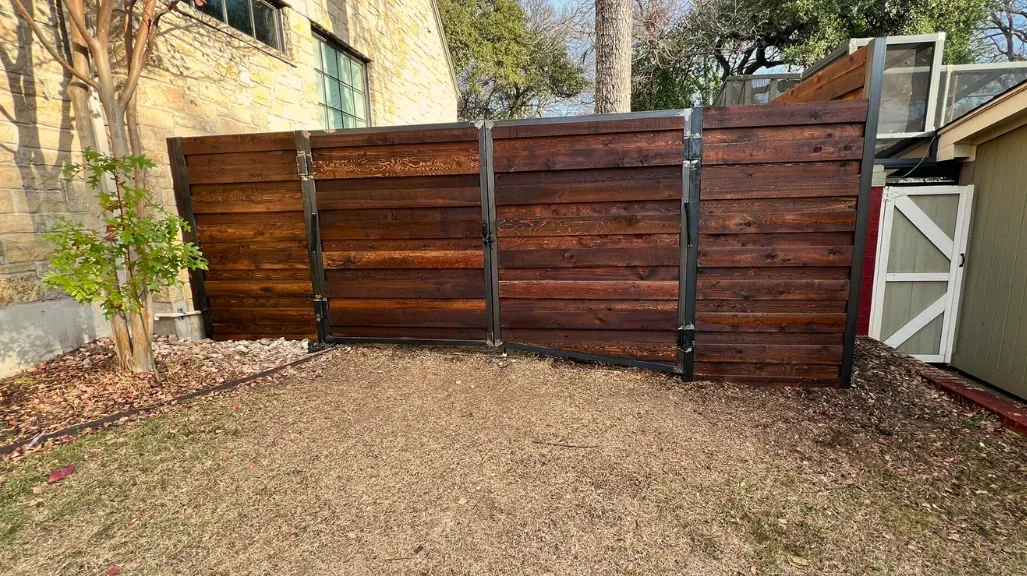
We have installed more cedar than every other wood combined since 2013. Western red cedar handles the Texas heat-and-cold cycle without warping if it’s milled to a consistent thickness and stained on schedule. The wood’s natural acids resist rot, which means the post-meets-picket joint stays sound longer than pressure-treated alternatives. Cedar also consistently takes HOA-spec stain colors, which matters in design-review-heavy areas like Twin Creeks and Avery Ranch.
For homeowners who want to go deeper on cedar specifics (species variants, grade differences, weathering profiles), see our dedicated cedar fence installation page. The short version: rough-sawn western red cedar in #2-grade or better, six-foot privacy with cap-and-trim, set with stainless or coated hardware.
Pressure-Treated Pine
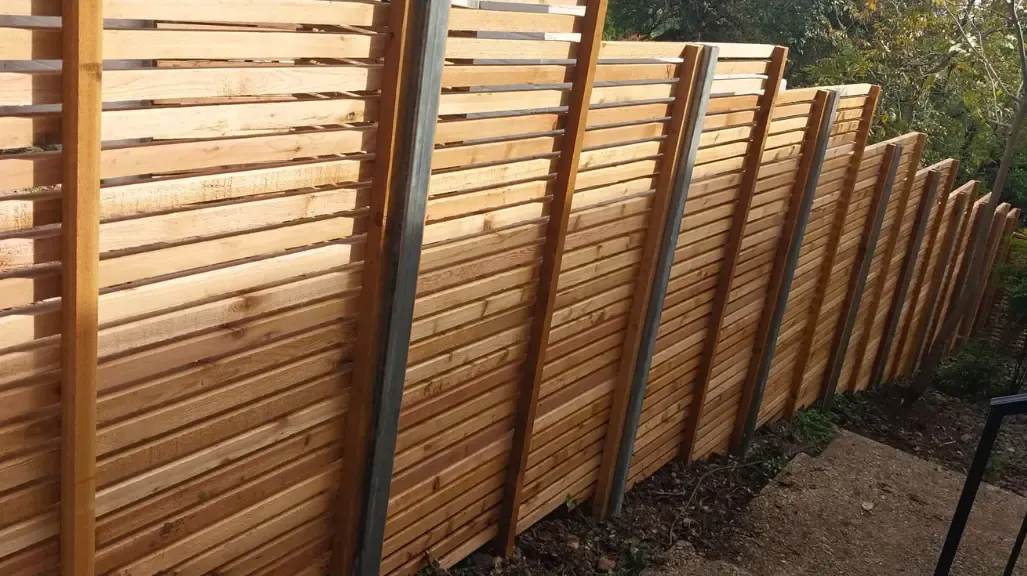
Pressure-treated pine is our second-most-installed wood, mostly in three project types: ranch perimeter, where appearance is secondary to function; utility fences for animal containment or yard separation; and structural elements (joists, rails, posts) on projects where the visible boards are cedar but the substructure isn’t visible. The price per foot is meaningfully lower than cedar, and the chemical treatment resists rot well in Texas soil.
The tradeoffs: pressure-treated pine doesn’t take stain absorption the way cedar does. The chemical treatment fights the stain, and the boards warp in Texas heat within a few years if they’re used as visible privacy pickets. We don’t install pressure-treated pine privacy fences in HOA neighborhoods because the look doesn’t hold up. For ranch and utility work where appearance is secondary, pressure-treated pine is the right call.

Redwood and Other Premium Woods
Redwood comes up on maybe one in twenty Cedar Park metro projects, usually on premium properties in Bee Cave or Lakeway, where the homeowner specifically wants the deeper red tone and is willing to pay for it. Redwood’s resistance to rot is comparable to cedar, but the cost is meaningfully higher, and the supply chain is less reliable in Central Texas than on the West Coast, where it’s milled.
Oak shows up occasionally on rustic-style properties or on fence-and-deck combined projects where the deck is also white oak. Less common as a pure fence material because the weight and density make it harder to work with on long perimeter runs.
Wood-Specific Build Details
Wood fences need build decisions that don’t apply to vinyl or chain link, and most cheap-bid contractors skip them because the difference doesn’t show until year five or year ten.
Heartwood-only pickets. Cedar’s rot resistance lives in the heartwood (the darker inner wood). Sapwood (the lighter outer wood) rots faster because it lacks the protective oils. Quality yards mill primarily heartwood; budget yards mix in sapwood that looks fine at install but rots from the bottom within five to seven years. We spec heartwood-only on every cedar order.
Kickboard along the ground line. Wood pickets that touch grade rot from the bottom because they wick soil moisture upward. We install a treated kickboard, a horizontal board running at ground level between the posts, as a sacrificial barrier. Pickets sit above the kickboard. When the kickboard rots in fifteen to twenty years, it’s a one-day swap rather than a full picket replacement. This is a wood-specific detail; vinyl and chain link don’t rot.
Expansion gap and picket direction. Cedar moves seasonally, expanding in humidity and contracting in dry summers, and pickets installed too tightly buckle within the first year. We space pickets to allow seasonal movement without visible winter gaps. We also orient the smooth side toward the neighbor (per HOA standards) and grain-match across project deliveries to ensure a consistent visual run.
Request a free estimate, and we’ll come out the same week.
HOA-Compliant Wood Fence Work
Most Cedar Park metro HOAs require a six-foot cedar privacy fence with cap-and-trim as the standard backyard fence palette. Specifications vary by neighborhood. Twin Creeks requires a tighter cap-and-trim profile than the regional standard, Liberty Hill HOAs allow more flexibility on visible-side details, and Round Rock HOAs split between active enforcement and dormant covenants. We confirm the specific HOA’s submittal requirements during the walkthrough and put together the approval package as part of the quote.
For homes outside HOA jurisdiction, local code applies (city-specific permit thresholds for fences over seven feet), and your own preference. We work with permit partners on any project requiring permitting.
Frequently Asked Questions
How long does a cedar fence last in Central Texas?
Cedar privacy fences with proper post depth, stainless hardware, and stain on a three-to-five-year cycle last fifteen to twenty years before reaching end-of-life. Fences with shallow posts or galvanized hardware fail at year eight to ten because the structural connections give out before the wood does. Stain timing matters for appearance and UV protection, but doesn’t determine structural life.
What's the difference between cedar and pressure-treated pine?
Cedar takes stain consistently, weathers to a warm tone, and resists rot through natural wood acids. Pressure-treated pine costs less per linear foot but doesn’t take stain well, warps in Texas heat when used as visible pickets, and relies on chemical treatment rather than natural rot resistance. Cedar for HOA privacy fences and visible runs; pressure-treated pine for ranch perimeter, utility work, and substructure framing.
Do I need to stain a new cedar fence?
We recommend the first stain coat be applied six to twelve months after installation, once the cedar has weathered enough to accept stain properly. Staining too early, before the boards have cured, can leave streaking. After the first coat, restain every three to five years, depending on sun exposure. Most Cedar Park HOAs require active stain matching to keep fences within the design palette.
Can you mix wood species on a single fence?
Yes, and it’s worth considering for budget projects. Visible pickets stay cedar (HOA palette and weathering profile matter on the visible run), but the substructure can be pressure-treated pine for posts, rails, and kickboard. Substructure isn’t visible after the pickets go up, and pine handles structural load well. Mixed-species fences run at a lower cost than full cedar and last comparably when post depth and hardware are right. Most HOAs allow this because rules cover what’s visible, not what’s behind it.
Should the wood pickets touch the ground?
No. Wood pickets that touch grade rot from the bottom because they wick soil moisture upward. We install a treated kickboard, a horizontal board running between the posts at grade, that takes the ground contact instead. Pickets sit above the kickboard with a small gap. When the kickboard rots, it’s a one-day swap; if the pickets rot, it’s a full-panel replacement.
Can you build wood fences taller than six feet?
Yes. Eight-foot privacy fences are common in Manor and on properties where homeowners want additional screening from nearby construction. Fences over seven feet require a city permit in most local jurisdictions; we handle the permit application as part of the project.
Do you offer fence repair, staining, and material-specific work?
Yes. Our fence repair team handles repairs to existing wood fences, and we install privacy fence installation projects across all material categories.
For staining maintenance on the recommended three- to five-year cycle, see our fence staining page.
Call (512) 566-7520 or visit our blog for installation guides and material-specific advice. We’ll walk the property within the week and leave with a written quote.