
What Cedar Park Fence & Deck Stands For
Cedar Park Fence & Deck builds fences and decks across the metro and broader Hill Country, with structural integrity that holds up for 15+ years, HOA-correct submittals on the first pass, line-item quotes, and the operational specifics that distinguish quality from cheap-bid work.
Most fence and deck contractors in the Austin metro position themselves the same way: lowest bid, fastest install, “we’ve been doing this for years.” We don’t compete on the lowest bid because the bids that win on price alone almost always cut corners on the things that determine whether the fence lasts. We compete on the work being right at year ten, year fifteen, and year twenty. That difference shows up in five operational areas that every project touches: post-depth, hardware, source materials, HOA expertise, and how we handle warranty conversations after installation.

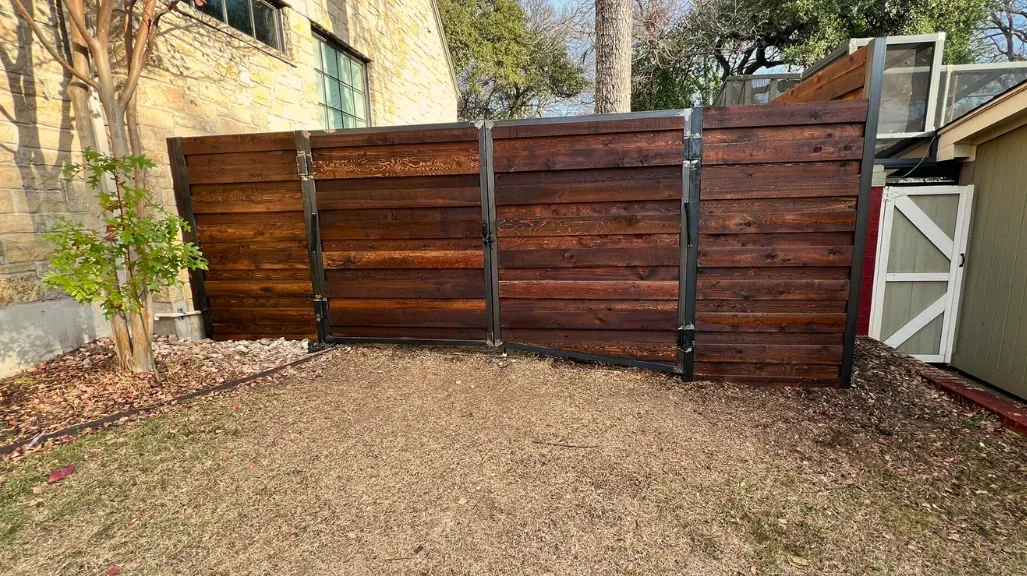
Founded in 2013, Family-Run, Veteran-Owned
The business started in 2013 as a family operation focused on residential fence work in Cedar Park, Leander, and Round Rock. Veteran ownership shapes how the business runs day-to-day: we follow process, we document everything, and we treat clients the way we’d want our own family treated on a major home project. The business has stayed family-run since the first install, which means the person who quotes your project is a stakeholder in the outcome rather than a salesperson chasing a commission target.
Family-run also means we keep the business small enough to supervise every project directly. We aren’t running fifteen crews simultaneously across half the metro. We run a manageable number of projects at any given time, with consistent crew leadership and a quality-control process that catches issues before they become warranty calls.
What We Build
We handle the full residential fence-and-deck spectrum across the Cedar Park metro:
Fence work covers new builds, repairs, and replacements. Six-foot cedar privacy fences with cap-and-trim are our most-installed configuration across HOA neighborhoods, and our wood fence installation page covers the broader wood-fence category, including pressure-treated pine and redwood.
The cedar fence installation page goes deeper on cedar species variants and stain cycle specifics. Cedar dominates our wood installs because of how it weathers and resists rot in the Texas climate.
Beyond wood, we handle vinyl fence installation on pool fence and low-maintenance applications, and chain link fence installation for pet containment, rural perimeter, and commercial work.
Deck work covers cedar and composite construction across single-level and multi-level designs. Composite has become the dominant deck material in the metro because of how it handles Texas heat and humidity over fifteen-plus-year cycles.
Maintenance and repairs are handled by our fence repair team for leaning posts, gate sag, board replacement, and the inevitable issues that arise over a fence’s life. Fence staining keeps cedar within the HOA palette on the recurring three-to-five-year stain cycle most communities require.
For the full process detail on how new fence installation works, our fence installation page covers post depth, hardware, gates, and the structural fundamentals that determine whether a fence lasts ten years or thirty.

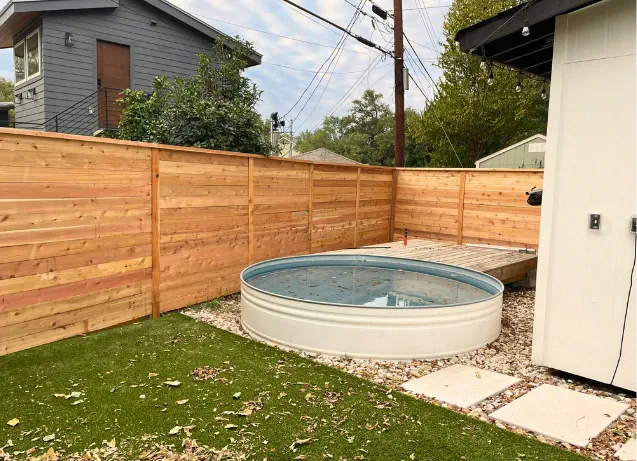
Geographic Coverage
Our service area centers on Cedar Park and extends across the broader Williamson and Travis County metro areas. If you’re inside roughly thirty miles of Cedar Park, we serve you.
In Williamson County, Round Rock and Leander make up most of our suburban work. Round Rock has 1990s-era subdivisions reaching twenty-year fence end-of-life simultaneously, and Leander tilts toward newer master-planned communities still building out HOA submittal pipelines.
Liberty Hill covers our acreage and ranch-style work west of Leander, where lots run larger and the soil shifts to caliche.
In Travis County, Lakeway and Bee Cave are our Hill Country and lake-adjacent markets. Premium-skewing properties, steep slopes, and lake-influenced humidity all require a different installation approach.
Manor on the eastern edge and Buda to the south round out the metro coverage. Black gumbo soil drainage in Manor and limestone bedrock in Buda each force their own post-setting adjustments.
What changes by city is the local conditions: caliche soil in west Leander and Liberty Hill, black gumbo in Manor, limestone in Buda, lake-influenced humidity in Lakeway and Bee Cave, and mature oaks in older Cedar Park neighborhoods. We adjust the install approach for each. The post-setting that works in Round Rock clay loam isn’t the same as what works in Buda limestone, and pretending otherwise results in fences leaning within five years.
Operating Standards That Show Up on Every Project
Five things that run through every project we do:
Written quotes with line-item materials. Every quote breaks out the cedar pickets, post hardware, gate hardware, concrete, and labor. Cheap-bid contractors hand over a single-line bottom-figure estimate. We don’t, because the line-item version lets you see exactly what you’re paying for and compare apples to apples against other bids.
Post depth set to spec. Six-foot fence posts go deep enough in concrete with a flared base; eight-foot posts go deeper. Cheap-bid spec is shallower in a smaller hole, and those fences lean within two to three years in Central Texas clay loam.
Stainless or coated hardware. Quality hardware on cedar work matters because cedar interacts with metal differently than other woods. The cost difference at installation is small; the difference at year ten is between a full hardware replacement and a fence that’s still structurally sound.
Permit partners. When a project requires a permit, we work with permit partners who handle the application. We don’t claim to handle permits in-house because that phrase implies a process we don’t actually run; the permit-partner approach is more honest about how the work actually gets done.
HOA submittals are correct on the first pass. Twin Creeks, Avery Ranch, Forest Creek, Travisso, The Hills of Lakeway, Sunfield, and most major Cedar Park metro HOAs have design review committees with specific palettes and submittal package requirements. We’ve handled enough projects in each to know what each committee looks for, so our submittals are approved on the first pass rather than triggering a two-to-four-week revision cycle.
What “Fully Insured” Actually Means
We carry general liability insurance and provide proof on request before any project starts. Texas doesn’t license fence and deck contractors at the state level, so the word “licensed” doesn’t carry meaning in our trade. What does carry meaning is the insurance certificate showing that if something goes wrong on your property during installation, the responsibility is properly insured rather than disputed. Most homeowners don’t ask to see insurance certificates because they assume any contractor must have them. The honest answer is that not every operator does, which is why we offer the certificate proactively.
Request a free estimate, and we’ll come out the same week.
How We Approach New Quotes
When you call (512) 566-7520, we schedule a same-week walkthrough at your property. We measure the proposed run, identify any HOA constraints, talk through material options that fit your specific situation, and discuss the operational specifics most contractors skip (post depth, hardware spec, stain cycle for cedar, gate hardware sizing). We leave with a written quote that breaks out line items so you can compare against other bids on equivalent terms.
If we’re not the right contractor for your project, sometimes the geographic distance is too far, or the project scope doesn’t match what we do well. We’ll tell you that during the walkthrough rather than chasing the bid.
We also publish ongoing guides and HOA-specific advice on our blog, covering topics like cedar species selection, HOA palette matching, chain link gauge specifications, and the operational details that distinguish a fifteen-year fence from a five-year fence.
Call (512) 566-7520 to schedule the walkthrough.