
What Fence Repair in Cedar Park Actually Covers
Fence repair in Cedar Park covers leaning posts, rotten sections, sagging gates that won’t latch, broken pickets, weathered cap-and-trim, and post replacement after irrigation or root damage. Most repairs run from half a day to two days, depending on the scope.
Most fences we repair across Liberty Hill and Manor failed for one of three reasons: posts set too shallow at installation, galvanized fasteners corroding inside the cedar, or storm damage that exposed an existing structural weakness. The first two are install-quality issues. The third is weather, and we get those calls every spring and fall when the seasonal storms move through.
We see the same pattern in Bee Cave and Buda. Fences that lasted twenty years in their first life fail at year four after a cheap-bid replacement. Post depth wasn’t right, fasteners weren’t stainless, and the failure mode was baked in before the storm hit. Our repair work fixes the immediate problem and identifies the root cause so the same section doesn’t fail next spring.
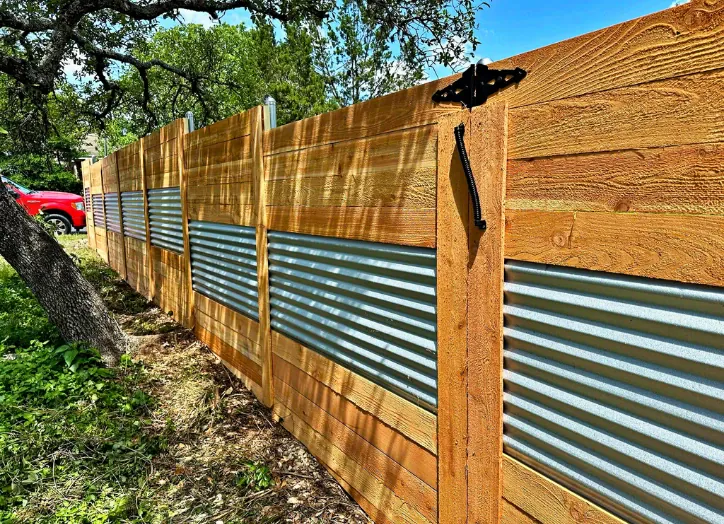
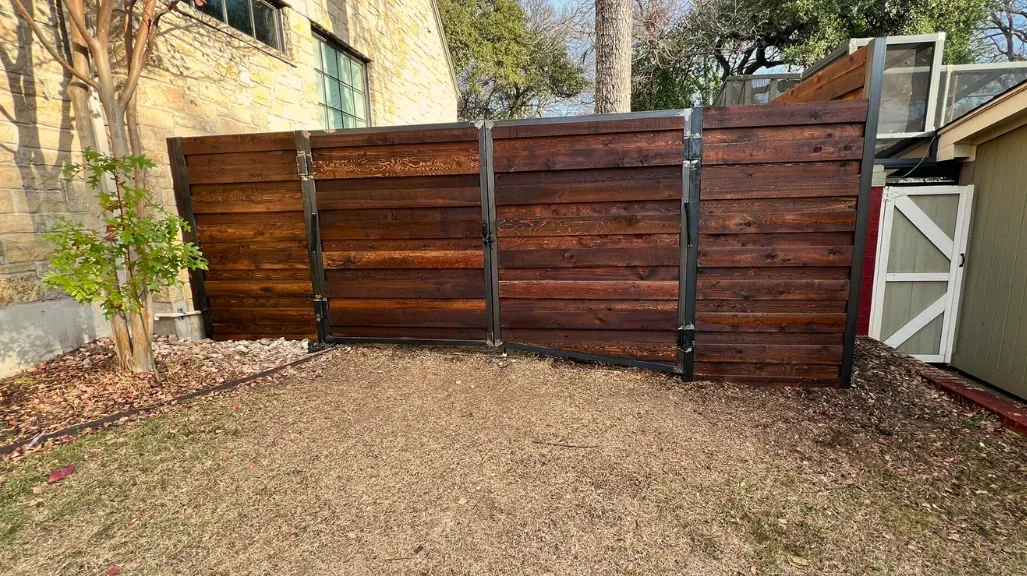
Common Fence Repairs We Handle
Leaning posts are our most frequent repair. Texas clay soil moves seasonally, and posts set shallow start tilting within two to three years. We pull the failed post, dig deeper and wider than the original, and reset it in concrete with a flared base. Half a day per post if the rest of the fence is sound.
Rotten sections come next. Cedar lasts twenty years if stained on schedule, but neglected fences gray, cup, and rot at the bottom rail where moisture sits. We pull the rotted boards, scribe or replace the bottom rail if needed, and install matched cedar pickets. If the rot spreads up the picket, we replace the entire picket rather than patch it.
Sagging gates are the most-noticed problem because homeowners interact with them daily. The cause is almost always one of two things: the gate post has settled, or the gate frame has racked due to a failed diagonal brace. We re-plumb the post if sound, install a new frame with a steel diagonal, and rehang with stainless hardware.
Storm damage is the seasonal call. A neighbor’s tree fell on a panel. A wind gust took a six-foot section. A downpour saturated the clay and tipped three posts at once. Insurance often covers storm damage, and we coordinate with the homeowner’s adjuster on documentation.
When Repair Stops Making Sense
Honest answer: when the fence is past the point of paying for itself. Three signals tell us a fence is at the end of its life rather than worth repairing.
The first is widespread post-failure. If half the posts on a 200-foot run are leaning, pulling, and resetting them all approaches the cost of a full new fence, and the new fence comes with a 20-year horizon. Replace, don’t patch.
The second is widespread picket rot. If bottom-rail moisture has worked up on most pickets, board replacement approaches full-picket replacement. Framing new pickets onto rotting rails is poor value.
The third is post-rust on chain link or pipe fence. Galvanized chain link rusts from the inside out, and once the post structure is compromised, replacement is the call.
We tell you which category your fence falls into during the walkthrough. We’ve quoted repair jobs and recommended replacement instead, and quoted replacement jobs and recommended repair instead. The honest call matches what’s actually wrong with your fence.
Request a free estimate, and we’ll come out the same week.
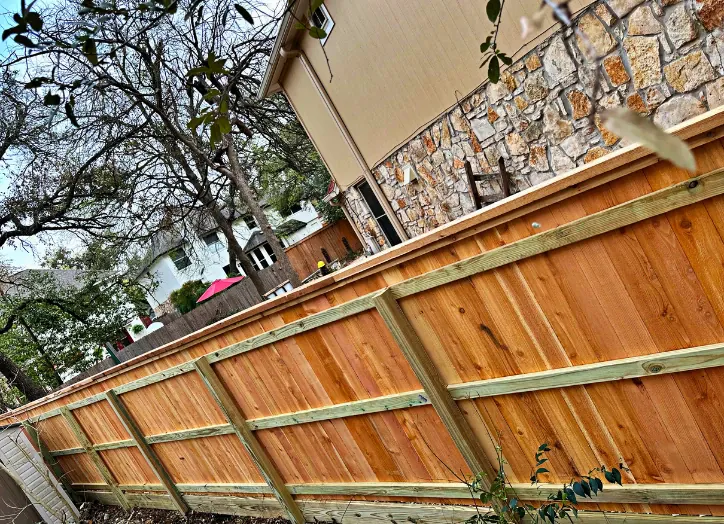
Storm Damage and Insurance Coordination
Texas storms move through fast and take fences with them. We get the highest call volume in late spring, after the May storms, and again in late fall, after cold fronts. Insurance covers most storm-related damage when the cause is clearly weather. We coordinate with the homeowner’s adjuster on photos, measurements, and scope so that claim documentation matches the actual damage.
A few points on insurance fence claims: the policy usually covers replacement of damaged sections, not the full perimeter. The deductible applies. Aged pickets are sometimes depreciated by the carrier. We document this in the written quote to avoid surprises.
Materials We Repair and Match
Cedar privacy fences make up about three-quarters of our repair work. We source matched cedar pickets from the yard we’ve used since 2013, so new boards weather to the same tone as the originals within a season. We repair vinyl section-by-section because most manufacturers produce predictable color matches. Chain link is mostly post-and-tension wire work. Wrought iron is welded, rust-treated, and coated with fresh powder.
Composite rails sometimes appear on fence-and-deck-combined projects in Lakeway and Bee Cave. We handle composite repair the same way as we do with wood: replace damaged components, blend the visual transition, and seal exposed structural members.
HOA-Compliant Repairs
Even repair work needs HOA approval in most Cedar Park neighborhoods. Twin Creeks, Avery Ranch, and Brushy Creek all have fence rules covering repairs and new builds. The standard rule: the repair matches the original color, material, and height. We confirm color matches before we start and put together documentation if the HOA needs sign-off.
For homes outside HOA jurisdiction, the repair scope is your call.
Areas We Serve for Fence Repair
Cedar Park is the home base. We handle fence repair across Williamson County and into the surrounding suburbs. Most projects run through Cedar Park, Leander, and Georgetown.
We also repair fences in Round Rock, Liberty Hill, Manor, and Buda, where larger lots support longer fence runs, and in Bee Cave and Lakeway, where Hill Country terrain means leaning posts on slopes are a regular call. If you’re inside roughly thirty miles of Cedar Park, we serve you.
Frequently Asked Questions
How fast can you get to a fence repair in Cedar Park?
Most repair calls get a same-week walkthrough. Storm damage in spring and fall sometimes pushes that to seven to ten days. If your fence is open and there are pets or kids on the property, we’ll prioritize same-week.
How much does fence repair cost in Cedar Park?
Repair cost depends on what’s failed and why. A single leaning post is half a day. A 50-foot section replacement is a full day or two. We don’t quote per linear foot because that hides the diagnosis. Every repair gets a written quote breaking down materials, labor, and scope before any work starts.
Can you repair a fence after a storm?
Yes. Storm damage is one of our most frequent calls in late spring and late fall. We document the damage with photos and measurements for your insurance claim, coordinate with the adjuster on scope, and complete the repair once the claim is approved.
Will the new pickets match the existing fence?
Cedar pickets weather to a similar tone within one season if from a comparable mill. We source from the yard we’ve used since 2013, so color and grain consistency are reliable. For a faster visual match, we recommend fence staining after the repair.
Do I need to be home for the repair?
For most exterior repairs, no. We can access most back yards through a side gate. We’ll confirm site access during the walkthrough so the day-of visit goes cleanly.
Can you fix a sagging gate?
Yes. Sagging gates are one of our most common repair calls. The fix is usually a gate post re-plumb plus a new gate frame with a proper steel diagonal brace. Half a day for most gates. We use stainless or coated hardware so the repair lasts longer than the original installation.
Do you work with HOAs on repair approvals?
Yes. Twin Creeks, Avery Ranch, Brushy Creek, and most Cedar Park HOAs require approval for fence repairs that change material, color, or height. We confirm requirements during the walkthrough and put together the documentation package on your behalf if needed.
Do you offer fence installation, staining, and privacy fence builds?
Yes. Beyond repair, we handle full fence installations for replacement projects and privacy fence installations when the existing fence is beyond repair.
Call (512) 566-7520 or visit our blog for repair guides and seasonal advice. We’ll walk the fence within the week and leave with a written quote.