
What We Build for Leander Homes
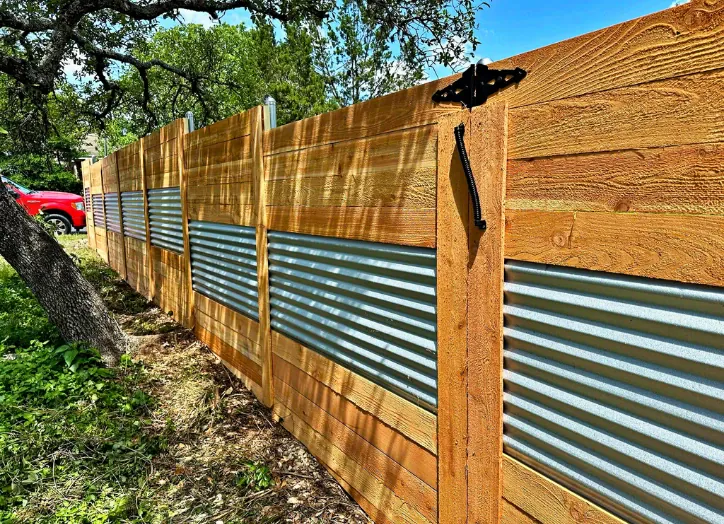
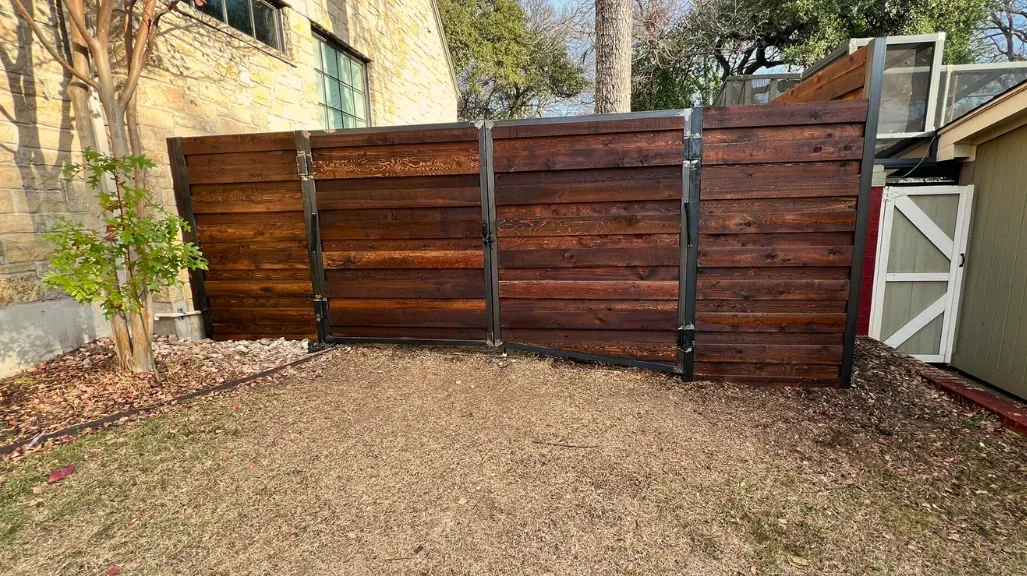
Fence and deck work in Leander includes six-foot cedar privacy fences for HOA neighborhoods like Travisso and Crystal Falls, four-foot ornamental iron for front-yard accents, deck installation on newer-build homes to add outdoor living, and HOA design submittals for phased developments.
The mix is different from what we build in Bee Cave, where pool fencing dominates, or in Manor, where black gumbo clay drives every install. Leander’s HOA palette is consistent: six-foot cedar privacy with cap-and-trim, four-foot ornamental iron front-yard accents, and single-level back-yard decks added after original construction.
What sets Leander apart is its construction age. Newer homes mean less repair work and more new installs. The flip side: HOA submittal pipelines remain active because phased developments continue to produce new lots.
Leander Subdivisions and Areas We Serve
Travisso is one of our most frequent service areas in Leander. Master-planned community on the west side with active design review across multiple phases, and a palette of six-foot cedar privacy with cap-and-trim. We’ve handled enough Travisso submittals to put together approval packages on the first pass.
Crystal Falls spans the northwestern edge of Leander with newer construction and active design committees. Six-foot cedar privacy with cap-and-trim is standard, and decks here are common because lot sizes accommodate larger back-yard builds.
Bryson and Reagan’s Overlook are master-planned communities with their own HOA rules. Cedar privacy with consistent stain color is the standard request, and we coordinate the submittal process for both.
Caballo Ranch holds larger-lot neighborhoods on the southern edge. Standard six-foot cedar privacy on most properties, with occasional eight-foot fences on the larger lots and four-foot ornamental iron on front-yard accents.
The unincorporated stretches off Bagdad Road and toward the Liberty Hill border don’t have HOA jurisdiction. Williamson County setbacks still apply, and the soil here is more likely to encounter caliche layers beneath the topsoil than in the central Leander neighborhoods. We work with permit partners on any project that requires permitting.
Materials That Work in Leander
Cedar dominates our wood installs across Leander, both for privacy fence installation and shorter front-yard runs. We use rough-sawn western red cedar pickets from the same yard we’ve used since 2013, and set six-foot fence posts thirty inches deep, minimum, in the clay loam that runs across most of the city. Composite is our most-installed deck material. Trex Transcend handles the full Texas sun, and TimberTech AZEK is the premium step up for cooler summer surfaces.
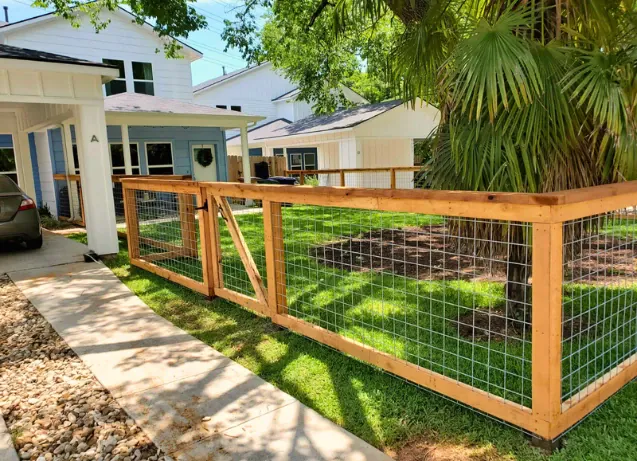
Aluminum and ornamental iron handle the four-foot front-yard fences common across Leander HOAs. We use galvanized hardware throughout. Vinyl is less common here than in some master-planned developments outside Texas, but we install it when an HOA palette allows.
We don’t install pressure-treated pine privacy fences in Leander. The chemical treatment fights stain absorption, and the boards warp in Texas heat within a few years.
Caliche and Post-Setting West of Leander
A meaningful share of Leander properties west of US 183 sit atop caliche layers a foot or two beneath topsoil, especially as you approach the Liberty Hill border. The hand-auger approach that works fine on flat clay loam in central Leander doesn’t work here. We bring rock-rated augers to every Leander quote and adjust the post-setting approach when we hit caliche. Rather than fighting through rock with a smaller hole, we step up to a wider auger or switch to mechanical drilling on harder layers. The post is still set in concrete with a flared base, regardless of soil type.
Request a free estimate, and we’ll come out the same week.
HOA Design Submittals on Phased Developments
The Leander-specific challenge isn’t material or terrain. It’s submittal volume on phased master-planned communities. Travisso and Crystal Falls continue to produce new homes monthly, and each new homeowner needs HOA-approved fence specifications before construction. We’ve handled enough of these to know what each design committee wants: spec sheet, height, picket spacing, stain color, gate placement, and a property-line diagram. Some require photographs. Some require neighbor notification on shared fences.
We put the submittal package together as part of the quote, not as a separate billable step. Doing it right the first time avoids the two-week delay that comes with a rejected submittal.
Why Local Knowledge Matters Here
Working in Leander is different from working in Cedar Park or Round Rock. Construction age skews newer, soil shifts more often within a single property, and HOA pipelines constantly produce new submittals on phased developments. A contractor working mostly in established neighborhoods doesn’t know that Travisso’s design committee meets twice a month, or that West Leander hits caliche at 12 to 18 inches in some spots. We’ll have the right submittal package together before we quote.
Areas We Serve Around Leander
Beyond Leander itself, we serve the surrounding northwest Williamson County area, including Cedar Park, Round Rock, Liberty Hill, Lago Vista, Cedar Hill, and the unincorporated stretches off Bagdad Road and toward the Liberty Hill border. We also cover the broader Austin metro from Lakeway up through Round Rock. If you’re inside roughly thirty miles of Cedar Park, we serve you.
Frequently Asked Questions
1. Do you work in Travisso and Crystal Falls?
Yes. Both are among our most frequent Leander service areas. Travisso’s west-side master-planned community runs an active design committee across multiple build phases; Crystal Falls’s northwestern phases have committee meetings on rotating schedules and somewhat looser palette enforcement than Travisso. We’ve handled enough projects in both communities to put together approval packages on the first pass.
2. What's the most common fence in Leander HOAs?
Six-foot cedar privacy with cap-and-trim is the standard request across Travisso, Crystal Falls, Bryson, Reagan’s Overlook, and most Leander master-planned communities. Leander’s distinctive feature is that most homes are recent enough that the fences are still in their first generation; the city’s growth means almost every project is a new install rather than a replacement. Front-yard accents are usually four-foot ornamental iron, with style approval running through the HOA committee.
3. How do you handle caliche under the soil?
We bring rock-rated augers to every Leander quote and adjust the approach when we hit caliche. On harder rock layers, we switch to mechanical drilling to set posts in properly-sized footings. The post is still set in concrete with a flared base, regardless of soil type. The cheap-bid approach is to set posts at twelve inches because the rock is in the way; we drill deeper.
4. Do all Leander HOAs require design review?
Most active HOAs do, including Travisso, Crystal Falls, Bryson, Reagan’s Overlook, and Caballo Ranch. Leander’s HOAs process more submittals per month than those in older cities because the city is still in active build-out. Travisso and Crystal Falls, in particular, have committee queues that turn weekly. The unincorporated stretches off Bagdad Road don’t have HOA jurisdiction. We confirm requirements during the walkthrough.
5. How long does a fence or deck project take in Leander?
Standard residential fence: two to four days. HOA fence with cap-and-trim: three to five days. Fence projects on west-side Leander properties that hit caliche layers add 1 to 2 days because rock drilling for each post slows the post-setting phase. Standard back-yard decks run four to seven business days. New-build homeowners coordinating with the original construction schedule should add a week to the HOA review timeline for phased developments. We’ll give you firm dates in the written quote.
6. Do I need a permit in Leander?
The City of Leander requires permits for fences over seven feet in height and for most attached decks more than thirty inches above grade. Leander’s permitting office is among the busiest in the metro area due to the city’s growth rate. The typical turnaround is one to two weeks, rather than the few days you’d see in slower-growth cities. Williamson County thresholds apply to unincorporated properties west and north of city limits. Our permit partners handle the application end-to-end when one is needed.
7. My home is brand new. When should I install the backyard fence?
Most Leander homeowners install the backyard fence within the first three to six months after closing. The HOA submittal process takes 1 to 3 weeks, depending on the committee meeting schedule, and the install runs 2 to 4 days after approval. Coordinate with us early if you want the fence in place before the first summer.
8. Do you offer fence installation, repair, and staining all together?
Yes. We handle full fence installation for new builds, repair on existing fences through our fence repair team, and fence staining to keep cedar fences within the HOA palette. Leander’s service mix tilts heavily toward new install rather than repair because most homes are recent enough that the fences haven’t aged into repair territory yet; most Leander clients book installation, then return for staining three to four years later as the cedar weathers in.