
What Vinyl Fence Installation Covers
Vinyl fence installation across Central Texas includes privacy panels in board-and-batten or tongue-and-groove profiles, decorative semi-private styles, four-foot pool surrounds that must meet Texas pool code, color options beyond white, and HOA submittal coordination for communities that permit vinyl.
The vinyl conversation breaks into three layers. First, panel system: vinyl comes as preassembled panels, not loose pickets, which changes installation pace and structural detail. Second, color and UV formulation: The Texas sun does specific things to white PVC over fifteen years. Third, when vinyl actually beats cedar on lifecycle cost.
For a broader context on fence installation, including structural fundamentals, see our fence installation page. This page is the vinyl-specific deep-dive.

When Vinyl Is the Right Call
Vinyl earns its spot in three specific scenarios across the Cedar Park metro area.
Pool fence applications. Texas pool code requires four-foot fences with self-latching gates and specific climbability standards around in-ground pools. Vinyl meets the code natively, doesn’t rust against chlorine and humidity that age aluminum brackets, and stays stable through the wet-dry cycle that breaks down powder-coated steel. Most of our pool fence installs in Bee Cave and Hill Country lake-adjacent properties go vinyl for this reason.
Homeowners who genuinely won’t maintain cedar. Cedar fences in HOA neighborhoods need to be stained every three to five years to stay within the community palette. Some homeowners book the cycle without thinking twice; others let it lapse and drift out of HOA compliance within five years. For the second group, vinyl is the honest answer: no stain cycle, no compliance drift, but a meaningfully higher upfront cost. The math works if the homeowner stays fifteen-plus years.
HOAs that explicitly allow or specify vinyl. A small number of Cedar Park metro HOAs allow vinyl as an alternative; an even smaller number specify it. We confirm the HOA’s palette during the walkthrough since rules vary from subdivision to subdivision.
When Vinyl Isn’t the Right Call
Three scenarios where we recommend cedar instead.
Homeowners are chasing low upfront costs. Vinyl runs meaningfully more per linear foot than cedar at install. The lifecycle math is favorable only if the homeowner stays long enough to amortize the upfront premium. For three- to five-year ownership horizons, cedar wins on first-decade total cost.
Properties with significant slope or terrain change. Vinyl panels are preassembled in fixed lengths, which means stepped panels along slopes look mechanical compared with how a board-on-board cedar fence steps down a Hill Country grade. Cedar adapts at the picket level; vinyl adapts at the panel level, and the difference is visible.
Strict HOA palette neighborhoods. Most Cedar Park metro HOA design committees have a developer-approved cedar palette. Twin Creeks, Avery Ranch, and most master-planned Cedar Park communities specify cedar with cap-and-trim and don’t permit vinyl. We confirm during the walkthrough.
Request a free estimate, and we’ll come out the same week.

Vinyl in Texas Sun
Vinyl is a UV-stabilized PVC formulation, and the manufacturer’s formulation determines how the fence looks at year ten. Quality vinyl uses titanium dioxide and other UV inhibitors that maintain its white color through fifteen-plus years of full Texas exposure. Budget vinyl skips the stabilizers and starts yellowing within five years, most visibly on south-facing runs.
We’ve specced vinyl from quality manufacturers with documented UV warranties since 2013. The cheap-bid vinyl big-box stores’ stock is fine for shaded northern installations, but meaningfully under-spec for the Cedar Park sun load.
Color Options Beyond White
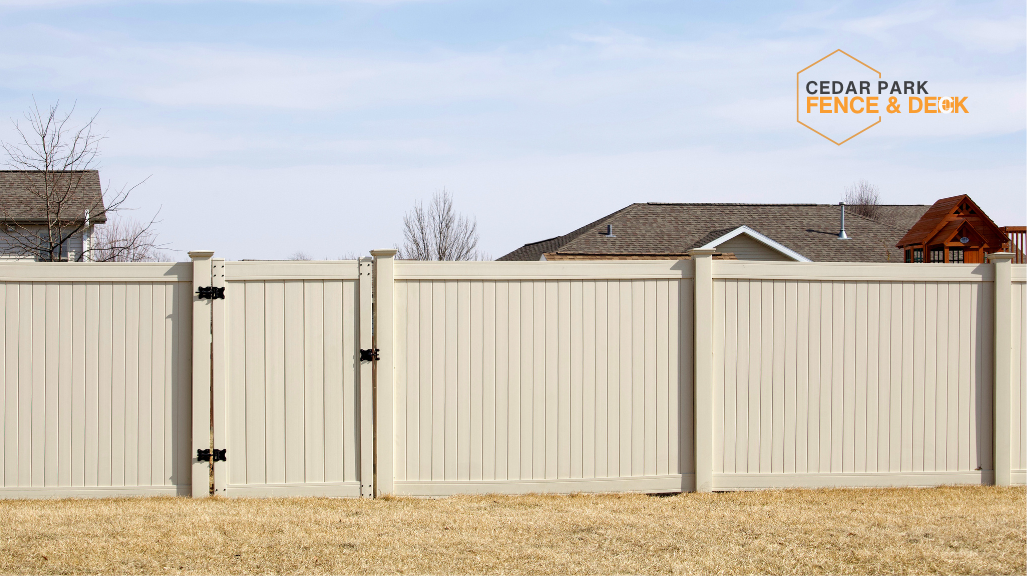
White is the default vinyl color, but it isn’t the only option. Tan, gray, and clay are available from quality manufacturers, and colored formulations fade less visibly than white because the underlying pigment is darker. Wood-grain-textured surfaces are also available, with an embossed grain that visually mimics cedar from a few feet back. Wood-grain texture costs more per linear foot but reads as wood from the street, which matters in HOAs that allow vinyl only in wood-tone colors.
For homeowners who want the cedar look without the cedar maintenance, wood-grain-texture vinyl is the closest match. The visual fidelity isn’t perfect, but it’s close enough that most neighbors won’t notice from the curb.
Vinyl-Specific Hardware
Vinyl panel systems use specific hardware different from wood-fence hardware in two ways. The brackets that secure panels to posts are aluminum or stainless steel rather than steel, because steel brackets corrode against the PVC interface and stain the visible panel face. Gate hinges and latches are heavier-gauge because vinyl panels weigh more than equivalent cedar panels, which stresses gate hardware more over time.
We use manufacturer-spec hardware on every vinyl install. Substituting cheaper steel hardware is the most common path to the rusted-bracket failure mode that dooms cheap vinyl fences.
HOAs That Allow Vinyl
A small number of Cedar Park metro HOAs allow vinyl as an alternative to cedar. The newer master-planned communities in Liberty Hill and on the eastern edge of Manor have looser palette requirements. Most established HOAs in central Cedar Park, Round Rock, and Leander require cedar.
For homeowners outside HOA jurisdiction, the only constraints are local code (city-specific permit thresholds for fences over seven feet) and your own preference. Vinyl is permitted everywhere outside the HOA jurisdiction.
Frequently Asked Questions
How long does a vinyl fence last in Texas?
Quality vinyl with documented UV warranties typically lasts 20 to 30 years before reaching end of life, longer than cedar’s 15- to 20-year window. Budget vinyl from big-box stores starts yellowing within five years. The lifecycle cost math favors quality vinyl over cedar only when the homeowner stays long enough to amortize the upfront premium.
Will a vinyl fence yellow in the Texas sun?
Quality UV-stabilized vinyl holds white pigment through fifteen-plus years of full Texas exposure with minimal yellowing. Budget vinyl without proper UV inhibitors starts yellowing within five years on south-facing runs. The manufacturer’s UV warranty (measured in decades, not seasons) is the indicator we ask about before specifying.
What's the most common style of vinyl fence?
Six-foot board-and-batten privacy panels are the most-installed vinyl style across the metro. The profile reads similar to cedar from the street, panels go up faster than picket-by-picket cedar work, and the configuration meets HOA privacy requirements where vinyl is permitted. Tongue-and-groove and decorative semi-private show up on a smaller share of installs.
Why is vinyl better than wood for pool fences?
Vinyl doesn’t rust against pool chlorine and doesn’t break down in the daily wet-dry cycle around in-ground pools. Aluminum and powder-coated steel pool fences corrode at the bracket-to-panel interface within a few years; vinyl is dimensionally stable. Vinyl pool fences also meet Texas pool code requirements for climbability and self-latching gates without modification.
Can you match a vinyl fence to my house color?
Quality manufacturers stock white, tan, gray, and clay as standard, plus wood-grain texture in cedar-tone and walnut-tone finishes. Custom colors aren’t typically available because UV stabilization changes the formulation. We pull the manufacturer’s color chart during the walkthrough.
Can vinyl handle a sloped lot?
Vinyl panels are preassembled in fixed lengths and step down slopes at the panel level. Mild slopes look fine; steep Hill Country slopes look mechanical compared with cedar. For homes with significant grade change, we usually recommend cedar regardless of stain-cycle preferences.
How does vinyl fence repair work?
Damaged panels swap out individually rather than picket-by-picket like cedar. Posts can be reset using the same techniques as wood. Bracket replacement is a common repair on older vinyl installs that used cheap steel hardware. Our fence repair team handles vinyl fence repairs throughout the metro.
Do you offer vinyl installation, repair, and other materials together?
Yes. We handle new fence builds in all materials, repair existing fences, and wood fence installation projects when cedar is the right call instead of vinyl. We don’t push one material; we recommend whichever fits the property, HOA, and homeowner timeline.
Call (512) 566-7520 or visit our blog for vinyl-specific guides and HOA palette details. We’ll walk the property within the week and leave with a written quote.